|
|
In March of 2009, Greek-Language.com was completely redesigned. The new alphabet page is now located at http://greek-language.com/Alphabet.html. Please update any bookmarks you may have to this page.
This
page will disappear sometime before the end of 2009 without warning, so
if there are any images here you wish to keep, please download them to
your own computer before the page disappears.
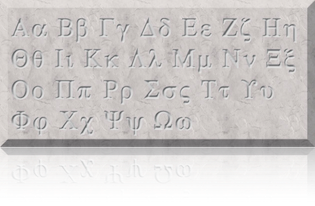
The alphabet presented below is the one used for printed Ancient Greek
texts. The earliest Greek texts that have survived were written with a
radically different script called Linear B.
For a detailed and wonderfully well
argued discussion of the origins of the Greek alphabet, see Roger D.
Woodard's book,
Greek Writing from Knossos to Homer.
For a discussion of the pronunciation suggestions given here, an
explanation of why the Erasmian pronunciation is not included, and
assistance with writing the letters, see below.
|
|
|
|
|
| Lower Case |
Upper Case |
Name |
Traditional English Transliteration |
Modern Greek Pronunciation |
Reconstructed
Classical Pronunciation (before 300 BC/BCE) |
|
|
|
Alpha |
a |
a as in father |
a as in father |
|
|
|
Beta |
b |
v as in vote |
b as in boat |
|
|
|
Gamma |
g |
g as in go, but
before vowels such as iota and epsilon, y as in yet,
and before gamma, kappa, xi, or chi, n as in sing
|
g as in go, but before gamma, kappa, xi, or
chi, n as in sing |
|
|
|
Delta |
d |
th as in then (but
not thin); contrast theta below |
d as in dog |
|
|
|
E-psilon |
e |
e as in set |
e as in set |
|
|
|
Zeta |
z |
z as in zoo |
sd
as in wisdom (Notice that the s is voiced like the z
in zoo) |
|
|
|
Eta |
e |
ee (/i/) as in meet |
e as in set, but held longer |
|
|
|
Theta |
th |
th as in thin (but
not then); contrast delta above |
asperated
t as in top (but not as in stop) |
|
|
|
Iota |
i |
ee (/i/) as in meet
or y as in yet |
short iota as i in it; long iota as ee
(/i/) in meet |
|
|
|
Kappa |
k |
ck as in sack |
unaspirated
ck as in nickle, but not aspirated k as in kite
|
|
|
|
Lambda |
l |
/l/ as in light
|
/l/ as in light |
|
|
|
Mu |
m |
/m/ as in mouse
|
/m/ as in mouse |
|
|
|
Nu |
n |
/n/ as in nose
|
/n/ as in nose |
|
|
|
Xi |
ks |
/ks/ as in kicks or x
as in ax |
/ks/ as in kicks or x as in ax
|
|
|
|
O-micron |
o |
/o/ as in tote or boat
|
/o/ as in tote or boat |
|
|
|
Pi |
p |
/p/ as in pan |
unaspirated
p as in sap, but not aspirated as in pass
|
|
|
|
Rho |
r |
/r/ more like the Spanish
trilled r than English r. |
a trilled /r/ like the Spanish r, not like English r.
|
|
|
|
Sigma |
s |
/s/ as in sister
|
/s/ as in sister, but z as in zoo
before beta, gamma, delta, and mu |
|
|
|
Tau |
t |
unaspirated /t/ as in stop
(but unlike top) |
unaspirated /t/ as in stop
(but unlike top) |
|
|
|
U-psilon |
u or y |
Like German ü |
short upsilon like the u in French tu;
long upsilon has the same sound, but held twice as
long |
|
|
|
Phi |
ph |
/f/ as in fan or phone
|
aspirated
p as in pot (not as in spot)
|
|
|
|
Chi |
ch |
Not found in English. Much like
Spanish "j". |
aspirated
k as in kit, but not in skit |
|
|
|
Psi |
ps |
/ps/ as in lips |
/ps/ as in lips |
|
|
|
O-mega |
|
/o/ as in tote |
like the vowel sound in caught,
but not like the vowel sound in cot. If you pronounce caught
and cot the same, click here.
|
|
Pronouncing the Greek Alphabet
Two sets of pronunciation suggestions are given
in the table above: first the pronunciation of each letter in Modern
Greek, then the reconstructed pronunciation for the Classical
period (before about 350 BCE).
The artificial Erasmian pronunciation used in
many schools to teach Biblical Greek and sometimes even Classical Greek
is not given on this page.
While neither the pronunciation suggestions given here
nor the Erasmian system acurately reflects the pronunciation of Greek
in the Hellenistic period of the New Testament and early Christianity,
a reconstructed pronunciation system for that period will be added
later.
To hear examples of Classical Greek texts read with the
reconstructed pitch accent system, visit the Classical Greek Pronunciation
page of the Commission for
Ancient Literature and Latin Tradition.
For a great demonstration of the
pronunciation of Modern Greek, see Harry Foundalis' discussion of
the Greek Alphabet. He confuses the Erasimian pronunciation with the
reconstructed pronunciation of Classical Greek, but his audio
demonstrations of Modern Greek pronunciation are extremely valuable.
A PDF file containing a fine discussion of the
history of Ancient Greek pronunciation by Carl Conrad, tracing its
development from Indo-european, can be downloaded by clicking on this
link.
I hope, in the future (no promises about how soon), to
add a pronunciation guide including both the Erasmian system and a
reconstruction of the actual pronunciation of the hellenistic period as
closely as it can be made at this time.
If you are learning Ancient Greek in a classroom
setting, imitate your instructor's pronunciation.
Displaying Greek on a Web Site
Are you interested in displaying Greek text on a
website? Consider using Unicode. You can view the numerical values for
the Greek letters at the
Web Design Group's web site.
Books on the Greek Alphabet
Roger D. Woodard's book, Greek Writing from Knossos
to Homer, is a wonderful combination of Classical Studies and
excellent understanding of Linguistics. He argues for an unbroken
history leading from the Linear B syllabary to the Greek Alphabet. The
argument is well documented and lucid.
In Homer and the Origin of the Greek Alphabet,
Barry Powell has written a provocative book asserting that the Greek
alphabet was designed intentionally for recording the works of Homer.
While Powell shows a thorough knowledge of the available evidence, his
proposal still rests on assumptions that cannot be fully tested.
Other Web Sites that Display the Greek Alphabet
There are many other sites on the internet that
show the Greek alphabet. Here are a few that provide particularly useful information:
|
|