Hellenistic Greek © 2008
Lesson 18: Future Tense Verbs
HellenisticGreek.com
Greek-Language.com
Suggest an improvement to this lesson.
HellenisticGreek.com
Greek-Language.com
Suggest an improvement to this lesson.
Present Tense
In this lesson you will review the verb forms for the Present Tense and expand your understanding of how they were used in Hellenistic Greek.
Future Tense
You will also learn the forms used for the future tense and see how they are related to the present tense forms.
Future Stem
Beginning with this lesson, the vocabulary list will include three forms for each verb, the present, future, and aorist. It is essential to learn all three.
The Greek future tense verb form conveys expectation. We have more than one way to convey expectation in English:
John will be here at 10:00am
John is coming at 10:00am
Both of these sentences convey the expectation that John will arrive at the stated time. Both could be expressed by the future tense form in Hellenistic Greek.
καὶ καλέσουσιν τὸ ὄνομα αὐτοῦ Ἐμμανουήλ
and they will call his name Emmanuel (Matthew 1:23)
κατακρινοῦσιν αὐτὸν θανάτῳ
They will condemn him to death
They are going to condemn him to death (Mark 10:33)
All Hellenistic Greek verbs form their future tense using the same endings as the present of Ω Conjugation verbs. You studied those endings in lesson 17. Take a moment to review them now.
|
Person |
Singular |
Plural |
||
|
Greek |
English |
Greek |
English |
|
|
First |
-ω |
I |
-ομεν |
we |
|
Second |
-εις |
you |
-ετε |
you |
|
Third |
-ει |
she, he, it |
-ουσι(ν) |
they |
Future tense verbs add a σ before these endings. For Ω Conjugation verbs, this σ (and the spelling changes it causes) will enable you to distinguish the future from the present tense. Distinguishing the future from the present of μι conjugation verbs is much easier since they do not use these endings for their present tense.
For many verbs, the addition of the σ to form the future
tense causes little change and is easy to recognize.
Observe the future tense forms of ἀκούω (I hear, I
listen).
|
Person |
Singular |
Plural |
||
|
Greek |
English |
Greek |
English |
|
|
First |
ἀκούσω |
I will hear, I will listen |
ἀκούσομεν |
We will hear, We will listen |
|
Second |
ἀκούσεις |
You will hear, You will listen |
ἀκούσετε |
You will hear, You will listen |
|
Third |
ἀκούσει |
She will listen, He will listen, It will listen,
etc. |
ἀκούσουσι(ν) |
They will hear, They will listen |
Exercise 1: Practice Recognizing Basic Future Tense Forms
Verbs to watch in this category: ἀκούω, ἀπολύω, πιστεύω
You saw in lesson 9 (The Aorist Tense and Aspect) that for verbs whose stems end with any one of several specific consonants, the addition of a σ to the end of the verb stem causes predictable spelling changes. The same changes that occur when the σ is added to produce the first aorist also apply to the future.
Review the consonant blend grid introduced in lesson 9:
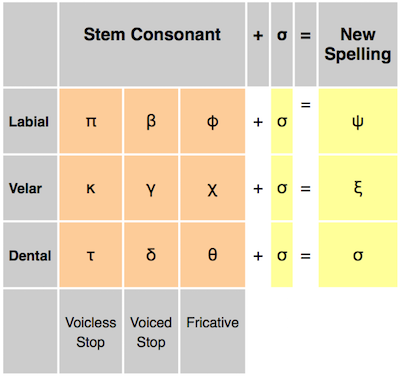
If the stem ends with a labial (a consonant produced using the lips), that labial will combine with the σ to produce ψ.
If it ends with a velar (a consonant produced by raising the back of the tongue toward the roof of the mouth), that velar with combine with the σ to produce ξ.
If the stem ends with a dental (a consonant produced by placing the tongue on or near the back of the teeth), that dental will be replaced by the σ.
Here are some examples of verbs whose stems end with a consonant from the consonant grid above:
|
Present |
Future |
||
|
πέμπω |
I send, appoint |
πέμψω |
I will send, appoint |
|
ἄγω |
I lead, bring |
ἄξω |
I will lead, bring |
|
πείθω |
I persuade [someone] |
πείσω |
I will persuade [someone] |
Exercise 2: Practice Recognizing Future Tense Spelling Changes
Verbs to watch in this category: πέμπω, ἀνοίγω, ἄγω, συνάγω, πείθω.
A siblilant is a consonant sound with a hissing effect, such as the sounds represented by the s in "sit," the z in "buzz," or the sh in "shell." Many languages exhibit special behavior to avoid two siblilants appearing together. In English, for example, a word that ends in a sibilant adds the sound combination /ɪz/ rather than /s/ or /z/ to form its plural.
|
No Stem-final Sibilant |
Stem-final Sibilant |
||
|
Singular |
Plural |
Singular |
Plural |
|
top |
tops |
house |
houses |
|
car |
cars |
box |
boxes |
|
wall |
walls |
church |
churches |
Greek also has special rules governing the placement of sibilants. Stems that end with ζ, for example, loose the ζ when a σ is added to the end of the stem, but stems ending with double σ (σσ) change the sibilant to ξ.
|
Present |
Future |
||
|
βαπτίζω |
I dip, immerse |
βαπτίσω |
I will dip, immerse |
|
κηρὐσσω |
I announce |
κηρύξω |
I will announce |
Exercise 3:Stem Final Sibilants
Verbs to watch in this category: βαπτίζω, δοξάζω, σώζω, κηρὐσσω
Verbs whose present tense stem ends with a liquid or nasal consonant (λ, ρ, μ, ν) also undergo predictable spelling changes. Just as with the σ for the first aorist, the σ for the future is omitted with these verbs. In stead of adding σ, the accent is moved from the verb stem to the ending. Double consonants are often reduced to a single consonant in the future tense, and other minor spelling changes may also occur. As you compare the forms below, pay special attention to where the accent marks are located.
|
Present |
Future |
||
|
βάλλω |
I throw, cast |
βαλῶ |
I will throw; I will cast |
|
αἴρω |
I take up, take away |
ἀρῶ |
I will take up, take away |
|
κρίνω |
I judge, prefer, consider, decide |
κρινῶ |
I will judge; I will prefer, etc. |
Exercise 4: Stem-final Liquid and Nasal Consonants
Verbs to watch in this category: αἴρω, ἀποκτείνω, ἀποστέλλω, βάλλω, ἐγείρω, ἐκβάλλω, κρίνω
Stems ending with a vowel do not contract in the future tense. The addition of the future tense σ separates the stem vowel from the connecting vowel, preventing contraction. For most of these verbs, the stem-final vowel lengthens when the σ tense sign is added.
|
Present |
Future |
||
|
γεννάω |
I give birth, become the father of, produce |
γεννήσω |
I will give birth, become the father of, produce |
|
θεωρέω |
I see, observe, watch |
θεωρήσω |
I will see, observe, watch |
|
πληρόω |
I fill, complete, finish, fulfill |
πληρώσω |
I will fill, complete, finish, fulfill |
In a few cases, though, this lengthening of the stem-final vowel does not occur. In lesson 9 you learned the verb καλέω (καλῶ), for example. It's future active indicative first singular form is καλέσω, not καλήσω.
Exercise 5: Contract Verbs
Verbs to watch in this category: ἀγαπάω, αἰτέω, ἀκολουθέω, γεννάω, ἐπερωτάω, ἐρωτάω, ζητέω, θεωρέω, καλέω, λαλέω, μαρτυρέω, παρακαλέω, περιπατέω, πληρόω, ποιέω.
In any language, some verbs are "irregular." That is, they do not follow the standard pattern. This is the case with two Greek verbs you have already learned. One of these verbs (λέγω) has future tense forms built on a stem that is radically different from its present tense stem (ἐρῶ). Another verb (εὐρίσκω) looses the syllable -ίσκ- and adds η before the future tense σ (εὑρήσω).
|
Present |
Future |
||
|
λέγω |
I say, speak, tell |
ἐρῶ |
I will say speak, tell |
|
εὑρίσκω |
I find |
εὑρήσω |
I will find |
These changes do not conform to the regular pattern discussed in this lesson. You must learn the future tense stem of these two verbs with special care. Study the chart on the right, then complete the exercise below. Notice that the future tense endings for λέγω / ἐρῶ look like those of a contract verb. The accent is on the ending rather than the stem. This does not happen with εὑρίσκω / εὑρήσω.
Exercise 6: Irregular Stems
Verbs to watch in this category: λέγω, εὑρίσκω
There are nine verbs in the Greek New Testament that use more than one verbal root. You will learn all of them in this course.
|
Present |
Future |
|
διδωμι |
δώσω |
|
τιθημι |
θήσω |
|
ἴστημι |
στήσω |
The present tense of -μι conjugation verbs has a reduplicated stem. That is, an extra syllable with ι is added to the beginning of the stem: διδωμι, τιθημι, ἴστημι. (To review reduplication, see lesson 17.)
In the future tense, this reduplication is eliminated and the same endings are added as for all other future active indicative verbs—the primary endings (listed at the beginning of this lesson).
Unlike the present tense, though, the length of the stem vowel does not alternate between the singular and plural forms. It remains long throughout. Compare the present and future forms of δίδωμι:
|
Singular |
||||
|
Present |
Future |
|||
|
1st |
δίδωμι |
I give |
δώσω |
I will give |
|
2nd |
δίδως |
You give |
δώσεις |
You will give |
|
3rd |
δίδωσι(ν) |
She, he, it gives |
δώσει |
She, he, it will give |
|
Plural |
||||
|
1st |
δίδομεν |
We give |
δὠσομεν |
We will give |
|
2nd |
δίδοτε |
You give |
δώσετε |
You will give |
|
3rd |
διδόασι(ν) |
They give |
δώσουσι(ν) |
They will give |
Exercise 7: -μι Conjugation
Verbs
Verbs to watch in this category: ἀφίημι, δίδωμι, ἴστημι, τίθημι.
Beginning with this lesson, every verb will be listed with three forms: the present, future, and aorist active indicative, first person singular.
|
56 |
ἐπερωτάω (ἐπερωτῶ), ἐπερωτήσω, ἐπηρώτησα |
I ask, inquire |
|
58 |
θεωρέω (θεωρῶ), θεωρήσω, ἐθεώρησα |
I see, look at, observe, watch |
|
52 |
πείθω, πείσω, ἔπεισα |
I persuade, exhort, encourage; I believe, trust |
|
Review You learned the following verbs earlier. Here the future tense forms are added. Review these verbs and learn the new forms. |
||
|
101 |
αἴρω, ἀρῶ, ἤρα |
I lift up, take up; I remove, take away |
|
122 |
βάλλω, βαλῶ, ἔβαλον |
I throw, cast |
|
77 |
βαπτίζω, βαπτίσω, ἐβάπτισα |
I dip, immerse |
|
133 |
βλέπω, βλέψω, ἔβλεψα |
I see, look at, observe, watch |
|
97 |
γεννάω, γεννήσω, ἐγέννησα |
I give birth, become the father of, produce |
|
191 |
γράφω, γράψω, ἔγραψα |
I write, record, compose |
|
97 |
διδάσκω, διδάξω, ἐδίδαξα |
I teach, instruct |
|
415 |
δίδωμι, δώσω, ἔδωκα |
I give |
|
61 |
δοξάζω, δοξάσω, ἐδόξασα |
I praise, honor, glorify |
|
155 |
ἴστημι, στήσω, ἔστην (ἔστησα) |
I place, put, set; I stand, stop, uphold |
|
148 |
καλέω (καλῶ), καλέσω, ἐκάλεσα |
I call, invite, address as, name |
|
114 |
κρίνω, κρινῶ, ἔκρινα |
I judge, prefer, consider, decide |
|
79 |
πέμπω, πέμψω, ἔπεμψα |
I send, commission, appoint |
|
86 |
πληρόω (πληρῶ), πληρώσω, ἐπλήρωσα |
I fill, complete, finish, fulfill |
|
100 |
τίθημι, θήσω, ἔθηκα |
I put, place, lay down |
1. καλέσεις τὸ ὄνομα αὐτοῦ Ἰησοῦν
You will call his name, "Jesus"
You will name him "Jesus" (Matthew 1:21)
2. αὐτὸς σώσει τὸν λαὸν αὐτοῦ
He will save his people (Matthew 1:21)
3. καὶ καλέσεις τὸ ὄνομα αὐτοῦ Ἰησοῦν· αὐτὸς γὰρ σώσει τὸν λαὸν αὐτοῦ τῶν ἁμαρτιῶν αὐτῶν.
And you will call his name “Jesus,” for he will save his people from their sins (Matt. 1.21)
4. [ὑμᾶς = you (plural, accusative case); ὕδωρ, ὕδατος = water]
Ἐγὼ. . . ὑμᾶς βαπτίζω ἐν ὕδατι. . .
I. . . baptize you with water. . . (Matthew 3:11)
The little preposition ἐν can be translated several different ways. Two common ways are "in" and "with."
The hammer is in (ἐν) the box.
He broke the window with (ἐν) a hammer.
To know which translation to use, you must decide if ἐν is being used to talk about location or the means by which something is done. Can you see why ἐν is translated as "with" in sentence 5 to the left?
5. αὐτὸς ὑμᾶς βαπτίσει ἐν πνεύματι ἁγίῳ καὶ πυρί
He will baptize you with the Holy Spirit and fire (Matthew 3:11)
If you would like to challenge yourself, try translating Mark 1:8. Look it up in your Greek New Testament and see if you can read it based on what you have learned here. Watch out! One of the verb forms is different from the ones in this verse from Matthew.
6. [κλείς, κλεῖδος = key; σοι = you (singular, dative case)]
δώσω σοι τὰς κλεῖδας τῆς βασιλείας τῶν οὐρανῶν
I will give to you the keys of the kingdom of heaven (Matthew 16:19)
I will give you the keys of the kingdom of the heavens
7. [εἷς, ἑνός = one, a]
ἐπερωτήσω ὑμᾶς ἕνα λόγον
I will ask you one thing (Mark 11:29)
I will ask you a question
8. In Luke 1:13 and angel speaks to Zechariah and tells him...
Ἐλισάβετ γεννήσει υἱόν σοι καὶ καλέσεις τὸ ὄνομα αὐτοῦ Ἰωάννην
Elizabeth will bear you a son, and you will call his name
"John" (Luke 1:13)
Elizabeth will bear you a son, and you will name him John.
9. δώσει αὐτῷ κύριος ὁ θεὸς τὸν θρόνον Δαυὶδ τοῦ πατρὸς σύτοῦ
The Lord God will give him the throne of his father David (Luke 1:32).
In the sentence above, since κύριος ὁ θεὸς is nominative case, it must be treated as the subject, meaning it must come first in the English translation. The dative case form αὐτῷ (him, to him) expresses the GOAL or RECIPIENT of the gift, and the accusative case phrase τὸν θρόνον expresses the PATIENT (the thing given). We could translate the sentence as above, or as
The Lord God will give the throne of his father David to him.
Both this translation and the one provided above correctly reflect the semantic roles of the nouns in relation to the verb.
10. [ἅ = what; δεῖ = it is necessary]
τὸ. . . ἅγιον πνεῦμα διδάξει ὑμᾶς. . . ἃ δεῖ εἰπεῖν.
The Holy Spirit will teach you. . . what is necessary to say.
11. [φυλακή = prison, jail; σε = you (accusative
singular)]
σε βαλεῖ εἰς φυλακήν
He will throw you in jail
12. [ὁ πράκτωρ = the officer]
ὁ πράκτωρ σε βαλεῖ εἰς φυλακήν
The officer will throw you in prison (Luke 12:58).
13. κρινῶ σε
I will judge you (Luke 19:22)
14. πέμψω τὸν υἱόν μου
I will send my son (Luke 20:13)
15. [τί = what?]
τί ἐροῦμεν;
What shall we say? (Romans 3:5)
What will we say?
16. [χρεία, -ας, ἡ = need; πᾶς, πᾶσα, πᾶν = all, every; ὑμῶν = your (plural)]
ὁ δὲ θεός μου πληρώσει πᾶσαν χρείαν ὑμῶν
And my God will fulfill your every need (Philippians 4:19)
17. ἐγὼ ἐρῶ σοι τὸ μυστήριον
I will tell you the mystery (Revelation 21:6)
18. [ὑπὲρ σοῦ = for you (singular)]
τὴν ψυχήν μου ὑπὲρ σοῦ θήσω
I will lay down my life for you (John 13:37)