Hellenistic Greek
© 2008, 2015, 2020
Lesson 1: The Alphabet (Lower Case Letters)
HellenisticGreek.com
Greek-Language.com
Suggest an improvement to this lesson.
HellenisticGreek.com
Greek-Language.com
Suggest an improvement to this lesson.
Recognize
You will learn to recognize the lower case Greek letters.
Pronounce
You will begin the process of learning to pronounce Greek words.
Write
You will learn to write the lower case letters of the Greek alphabet.
This lesson introduces you to most of the sounds and letters necessary to read Hellenistic Greek. Only the lower case letters are included in the chart below. The upper case (capital) letters will be introduced in the next lesson.
In the table below three pronunciation systems are shown. The first is the pronunciation used by Modern Greek speakers. The second is the pronunciation of Greek in the late Hellenistic Period, the time of the birth of early Christianity. The third is the artificial (“Erasmian”) pronunciation still used in some Biblical Greek classes.
In class you should repeat the sound associated with each letter following the example of your instructor.
For many of the consonants in the table below, the audio provided pronounces the consonant followed by the vowel sound /a:/ (as in father or clock) so that you can hear how the consonant should sound at the beginning of a word, then both preceded and followed by that same vowel so that you can hear how it should sound in the middle of a word.
| Lower Case Letter | Name | Pronunciation | ||
|---|---|---|---|---|
| Modern | Koine | Erasmian | ||
|
α |
ἄλφα Alpha |
/a:/ as in “father” |
/a:/ as in “father” |
/a:/ as in “father” or sometimes /æ/ as cat |
|
β |
βῆτα Beta |
/v/ as in “vat” |
v as in "vote" (but more like Spanish b/v in vaca and bote) |
/b/ as in “bat” |
|
γ |
γάμμα Gamma |
/g/ as in “go” but /y/ as in “yet” before /i/ or /e/ sounds |
Softer than the g in "get", more like Spanish g in lago |
/g/ as in “go” |
|
δ |
δέλτα Delta |
/ð/ (th) as in “then” but not /θ/ as in “thin” (Contrast below.) |
th as in then (but not thin. Contrast theta (θ) below. |
/d/ as in “dog” |
|
ε |
ἒψιλόν E-psilon |
/e/ as in “set” |
e as in set |
/e/ as in “set” |
|
ζ |
ζῆτα Zeta |
/z/ as in “daze” |
z as in zoo |
/z/ as in “daze” |
|
η |
ῆτα Eta |
/i/ as in “machine” and "seen" |
/e/ like the first part of the a in late |
/eɪ/ as in “daze” and "weight" |
|
θ |
θέτα Theta |
/θ/ as in “thin” but not /ð/ as in “then” (Contrast δ above.) |
th as in thin, but not in then. Contrast delta (δ) above. |
/θ/ as in “thin” but not /ð/ as in “then” |
|
ι |
ἰῶτα Iota |
/i/ as in “machine” and "seen" |
ee (/i/) as in meet, |
/i/ as in “machine” (long) or /ɪ/ as in “fit” (short) |
|
κ |
κάππα Kappa |
/k/ as in “kitchen” |
unaspirated ck as in nickle,
|
/k/ as in “kitchen” |
|
λ |
λάμβδα Lambda |
/l/ as in “little” |
l as in light |
/l/ as in “little” |
|
μ |
μῦ Mu |
/m/ as in “me” |
m as in mouse |
/m/ as in “me” |
|
ν |
νῦ Nu |
/n/ as in “knee” |
n as in nose |
/n/ as in “knee” |
| ξ | ξεῖ Xi | /ks/ as in kicks or x as in ax | ks as in kicks |
/ks/ as in kicks or x as in ax |
|
ὀ |
ὂμικρόν O-micron |
/o/ as in “tote” or “boat” |
o as in tote or boat |
/ɒ/ as in “not” or “cot” |
|
π |
πεῖ Pi |
/p/ as in “pan” |
unaspirated /p/ as in span,
|
/p/ as in “pan” |
|
ρ |
ῥῶ Rho |
/R/ more like the Spanish trilled r than English r. |
a trilled /r/ like Spanish r, not like English r |
/r/ as in read. |
|
σ, ς |
σῖγμα Sigma |
/s/ as in “sister” |
/s/ as in sister, |
/s/ as in “sister” |
|
τ |
ταῦ Tau |
unaspirated /t/ as in “stop” (but unlike “top”) |
unaspirated /t/ |
/t/ as in stop or top |
|
υ |
ὒψιλόν U-psilon |
/y/ like German ü |
similar to German ü /y/ |
/y/ like German ü, or sometimes /u/ as in “rule” or even /ʊ/ as in “hook” |
|
φ |
φεῖ Phi |
/f/ as in “fan” or “phone” |
/f/ as in fan or phone |
/f/ as in fan or phone |
|
χ |
χεῖ Chi |
/χ/ Not found in English (unless you pronounce the ch in "loch" like some Canadians do!). Much like Spanish “j” |
Not found in English, like Spanish j |
/χ/ Not found in English. Much like Spanish “j” |
|
ψ |
ψεῖ Psi |
/ps/ as in “lips” |
ps as in lips |
/ps/ as in “lips” |
|
ω |
ὦμέγα O-mega |
/o/ as in “tote” |
o as in tote or boat |
/o/ as in “tote” |
Notice that there are two forms of lower case sigma. One (ς) is used only as the final letter in a word and is thus called “final sigma.” The other (σ) may be used anywhere else. Some examples are: σῶμα (body), ἐκκλησία (church), ἥλιος (sun).
Several common combinations of two vowel letters have traditionally been called diphthongs. By the Hellenistic period, they were no longer pronounced as true diphthongs, however (two vowel sounds slurred together into one continuous, yet shifting sound). Several would more properly be called “digraphs” (two letters used together to represent a single sound). Others represent the combination of one vowel sound with a consonantal sound. In this course we will call them simply "Letter Pairs".
These letter pairs (traditional diphthongs) are as follows.
Representing a single vowel sound in the Hellenistic Period:
| Letter Pair | Pronunciation | Greek Example | ||
|---|---|---|---|---|
| Modern | Koine | Erasmian | ||
|
αι |
/e/ as in “bet” |
/e/ as in “bet” |
/aɪ/ as in aisle |
αἰτέω (request, demand) |
|
ει |
/i/ as in machine |
/i/ as in machine |
/eɪ/as in eight |
εἰρήνη (peace) |
|
οι |
/i/ as in machine |
/y/ like German ü |
/oɪ/ as in oil |
οἶκος (house, home) |
|
ου |
/u/ as in “boot” or “soup” |
/u/ as in “boot” or “soup” |
/u/ as in “boot” or “soup” |
οὐρανός (heaven, sky) |
Representing a semivowel plus a vowel in the Hellenistic Period:
| Letter Pair | Pronunciation | Greek Example | ||
|---|---|---|---|---|
| Modern | Koine | Erasmian | ||
|
υι |
/ι/ as in machine |
/uɪ/ as in suite |
/uɪ/ as in suite |
υἱός (child, descendant, son) |
Representing a vowel sound plus a consonantal sound in the Hellenistic Period:
| Letter Pair | Pronunciation | Greek Example | ||
|---|---|---|---|---|
| Modern | Koine | Erasmian | ||
|
αυ |
/av/ as in “of” before s, voiced consonants (b,g,d,z,l,m,n,r), or any vowel; /af/ as in “prof” (short for “professor”) before all other letters |
/av/ as in “of” before s, voiced consonants (b,g,d,z,l,m,n,r), or any vowel; /af/ as in “prof” (short for “professor”) before all other letters |
/au/ as in "out" or "house" |
αὐτός (he, she, it) |
|
ευ |
/ev/ as in “ever” or /ef/ as in “effort” following the same rule as for αυ |
/ev/ as in “ever” or /ef/ as in “effort” following the same rule as for αυ |
/ɪu/ as in feud |
εὐθύς (immediately) |
Diaeresis. A diaeresis (¨) is placed over the second letter of a pair of vowels which would otherwise form a diphthong to indicate that they do not form a diphthong and are to be pronounced individually. Example: Ἠσαΐας (Isaiah).
Consonant Pairs. Several combinations of two consonant letters are worth special attention. These are as follows:
| Letter Pair | Pronunciation | Greek Example | ||
|---|---|---|---|---|
| Modern | Koine | Erasmian | ||
|
γγ |
/ŋ/ as in “anger” or “sing” |
/ŋ/ as in “anger” or “sing” |
ἄγγελος (angel) is pronounced as angelos. |
|
|
γκ |
/ŋk/ as in “ink” |
/ŋk/ as in “ink” |
ἀγκάλη (arm) is pronouned ankali. |
|
|
γχ |
/ŋχ/ Not found in English. You may substitute /ŋk/ as “ink” or “anchor” |
/ŋχ/ Not found in English. You may substitute /ŋk/ as “ink” or “anchor” |
ἐγχρίω (I annoint) may be pronounced enkrio. |
|
|
μπ |
/mb/ in the middle of words. /b/ elsewhere |
/mp/ (no change from the separate letters) |
πέμπω (I send) is pronounced pembo in Modern Greek, but pempo in the Erasmian system. |
|
|
ντ |
/nd/ in the middle of words. /d/ elsewhere |
/nt/ (no change from the separate letters |
Ἀντιπας (Antipas) is pronounced andipas in Modern Greek, but antipas in the Erasmian system. |
|
Learn to pronounce the name of each letter. In pronouncing the name you also say the sound the letter represents.
A few lower case Greek letters look like, but are not pronounced like some English letters. These should be learned carefully to avoid confusion. They are:
Learn these letters especially well.
Some other letters resemble English letters and are pronounced similarly to their English counterparts. α, ε, κ, ο, and τ, for example, should pose few problems.
The rest of the letters, while not causing special confusion, must simply be memorized. λ, μ, ξ, π, φ, and ψ bear no particular resemblance to English letters. Look at each one and pronounce it several times. Learn the name for each letter.
σκορπίος
με
μέγα
ἀπόστολος
τῆλε
μαραθών
ἀπαθεία
The following words may be entirely unfamiliar to you, but in each case we have a related English loan-word from Greek. Observe each Greek word and compare it to the English translation given. Does the related English loan-word help you understand the meaning of the Greek word?
δόγμα
decree, law (Our English word dogma, meaning "a principle or set of principles imposed by authority", is derived from this Greek word.)
ὀφθαλμός
eye (Our English word ophthalmologist means, "eye doctor".)
ἀρχή
beginning (Our English word archaeology, meaning study of the remains from ancient times, is derived from this Greek word.)
καρδία
heart (Our English word cardiac, meaning "relating to the heart", is derived from this Greek word.)
ἀκούω
I hear (Our English word acoustic is based on this Greek word.)
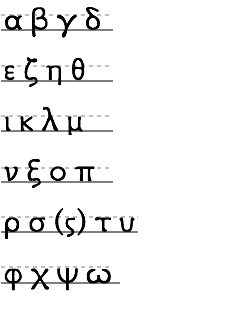
Look at the letters on the left. Note the relationship of each one to the solid line below it and the dotted line above. Some letters extend below the solid line. While most lower-case letters fit neatly between the solid line and the dotted line, some extend above the dotted line. A few letters both extend below the solid line and above the dotted line.
Click on the image of the alphabet to the left to print a practice page. You should be able to write all but three of them with a single continuous stroke. The three that require two strokes are τ, χ, and ψ.
If you are learning Greek in a classroom setting, your instructor may ask to see your work. Write as neatly as you can.